Note - in some browsers the appearance of the blog is corrupted. I do not yet know the cause, but hope this issue will be resolved soon!

Friday, 21 June 2013

Wetlands International surveys II

It's been a while since my last update. I have been rather busy with work and also was in Europe for 10 days, part work and part meeting up with friends. It felt good to be back in Europe for a while, it's hard to beat enjoying good food with old friends on a long summer evening.

The second dedicated bird surveys for the Wetlands International project started when I was away last week (for an introduction to the WI project, see a previous post: wetlands international survey). WI is doing an excellent job pulling in the experts: after Dennis Yong, this time Dave Bakewell is leading the bird surveys. Dave is one of the foremost bird experts in the region and hardly needs an introduction. If you have never visited his weblog than please do so at dig deep, a great read and teeming with useful information on bird identification.

Again I have again been lucky to be invited to help out. Last Thursday I joined one of the surveys, which was an excellent way to rid myself quickly of the jet lag. We met up in the early morning to explore the more remote areas of peat swamp and kerangas forests that are typical of the lower Belait district. On the way we saw a lesser adjutant, a good omen! At our first locality we had good, though slightly distant, views of a male scarlet-breasted flowerpecker. This is not an easy bird to find and I am very happy that I got a few shots of this splendid little bird!
Crimson-breasted flowerpecker (Prionochilus thoracicus).
There was plenty of other bird activity, though most was out of reach of my camera. Rare birds elsewhere, cinnamon-headed green pigeons are a relatively common sight in the open areas and we spotted several smaller flocks. A group of thick-billed green pigeons had joined the cinnamon-headeds in the tree pictured below, before flying of:
Cinnamon-headed green pigeons (Treron fulvicollis) and
 Thick-billed green pigeons (Treron curvirostra).

With Angus, Dave and Kolbjorn.
When we moved to the next locality we soon heard a species that has eluded me for the past 3 years: the hook-billed bulbul! This is a peat swamp specialist, and there is no surprise that it is found here. Pristine peat swamp forest is getting increasingly scarce on Borneo and with the rapid disappearance of suitable habitat this species is listed as threatened (vulnerable) by IUCN.
Hook-billed bulbul (Setornis criniger). 
And so I finally added this long awaited lifer to my Bruneian list. In the below picture the distinctive white tail tips can clearly be seen - most of the head is however well hidden behind a branch and I will definitely need to try for better photographs in the future!
Hook-billed bulbul (Setornis criniger).
We continued again at dusk with the aim to get Dave good pictures of the Bonaparte's nightjar. Around the Badas area literally thousands(!) of flying foxes can be observed as they fly over to their preferred fruiting spots. The flying fox is the largest flying mammal and it is a very surreal sight to see so many big bats flying overhead in an almost continuous stream, it delivers a vague sense of being part of the latest vampire movie.
These mass wanderings seem a recurring phenomenon, as I had witnessed it before in 2010 and I suspect they are related to temporary localized fruiting periods. With the dusk setting in I failed to capture a good impression of the full scale of the bats passing by, but I did get some shots of individuals flying over.
Large flying fox (Pteropus vampyrus).
Batman!
We did hear and see the nightjar, but the bird couldn't be tempted to show itself well enough for any pictures. While waiting for the nightjar a colugo soared by overhead, landing not too far away from us. These animals can truly glide, I estimate that this individual covered at least a 100 meters with a single jump/glide/flight.
Sunda flying lemur or Colugo (Galeopterus variegatus).
Note the little peeping Tom.
These trips into the more remote parts of the lower Belait seem to imply that some of the species typically associated with nutrient-deficient soil forests are especially sensitive to disturbance. While I have recorded some great birds in the past 3 years along the Kuala Balai road I have never seen hook-billed bulbul and scarlet-breasted flowerpecker there and only very rarely encounter cinnamon-headed green pigeons: one could hypothesize that the road and related activity has a clear negative effect on the presence of the aforementioned species. With the ever expanding human encroachment on nature the efforts of Wetlands International will be an important step towards building a sustainable future for the lower Belait forests. I am anxiously looking forward to the findings and recommendations of this project.

Folkert, 21/06/2013

Sunday, 19 May 2013

KB road, yet again.

A little feedback from the past week, starting with a morning trip to KB road this weekend. The morning was relatively productive, I even saw another black-and-white bulbul, but I have very little to show for. I did however manage to get some shots of the ruby-cheeked sunbird, which I consider to be my best so far. Here is the male:
Male Ruby-cheeked sunbird (Chalcoparia singalensis).
And again, now showing the origin of its name.
Male Ruby-cheeked sunbird (Chalcoparia singalensis).
At first I thought this pair was feeding, but soon realized that they were returning to the same branch because they were laying the foundation of their new home. Here is the female, carrying some nesting material.
Female Ruby-cheeked sunbird (Chalcoparia singalensis).
The only other bird picture I find worth showing is of this buff-rumped woodpecker that I found foraging in the trees. This small woodpecker is one of the more common woodpeckers seen. 
Buff-rumped woodpecker (Meiglyptes tristis).
When I drove home, I noticed a large group of silver leaf monkeys and watched them for a while from my car. The massive jumps they made from one tree to the next is really impressive. Here is one animal taking off.
Silver Langur (Trachypithecus cristatus).
The siliver langur, or silver(ed) leaf monkey is listed as near threatened by IUCN. Luckily they're still reasonably often encountered in Brunei. There is even one group in Panaga, which is very unique situation (see also an earlier post, my garden birds ii, August 2012).

As some of you may have discerned from previous posts, we also attempt to explore the fauna around Panaga during the evening hours. Last Thursday Kolbjorn, together with his two kids Hannah and Jonas, and myself went out for an evening drive on KB road.

This was the first time I drove down KB road during an evening shower. The low-hanging fog, that accompanies the rain while it evaporates on the still hot tarmac of the road, creates a very eerie atmosphere. With the amount of rain we quickly abandoned the idea of spotlighting and focused our attention mainly on the area in front of us that was illuminated by the car's headlights. And we soon found that we weren't the only ones: when I put on the breaks to avoid running over a little frog we were astonished to see a Buffy fish owl swooping down to pick it up, just two meters in front of us. What a sight! 
It quickly became apparent that the wet road becomes a preferred hunting ground for the Buffy fish-owls. We counted no less than 7 different birds - without the aid of any spotlighting! With their hunting accuracy any frog that crosses the road puts its life in serious danger.
Buffy fish-owl (Ketupa ketupu) in the rain.
On the way back it even got better when we spotted this Wagler's pit viper. This is one of the more common Bornean snakes. Adults get to about a meter in length, this youngster was only around 30 centimeters and still had stunning bright green colors. It is a true nocturnal species; they are very docile and sluggish during the day, often found motionless for hours on the same branch. Even though bites are rare, care should always be taken with these snakes, Wagler's pitviper is poisonous and its venom really packs a punch!
Juvenile Wagler's pitviper (Tropidolaemus wagleri).
The snake pictures were taken without flash and I am very pleased with the results; all the credit goes to Hannah though, without her perfect support holding the torch we would have nothing to show for. Thanks Hannah!

Folkert, 19/05/2013.

Monday, 13 May 2013

KB road in spring

I had planned to spend some of the morning hours at KB road on my Friday off. As it happened it was pouring down when I got up and I needed very little persuasion to return my head back to my pillow. Luckily, the weather promised to be much better the next day and at Saturday 6 AM I turned onto KB road in a highly upbeat mood.

Some bushes next to the road were fruiting and there were plenty of bulbuls around, mostly black-headed, but I also saw a puff-backed bulbul which is an uncommon encounter at KB road. After a couple of minutes the star of the morning flew in: a male black-and-white bulbul.
Male black-and-white bulbul (Pycnonotus melanoleucus).
This first picture is really not very good. I was shooting against the light with a slightly fogged up lens. And not only that, I also still had my camera in a fixed setting from the previous night! Not very smart. It's hard to explain the anguish when failing to make the most of a perfect photo opportunity of a hard to get bird.

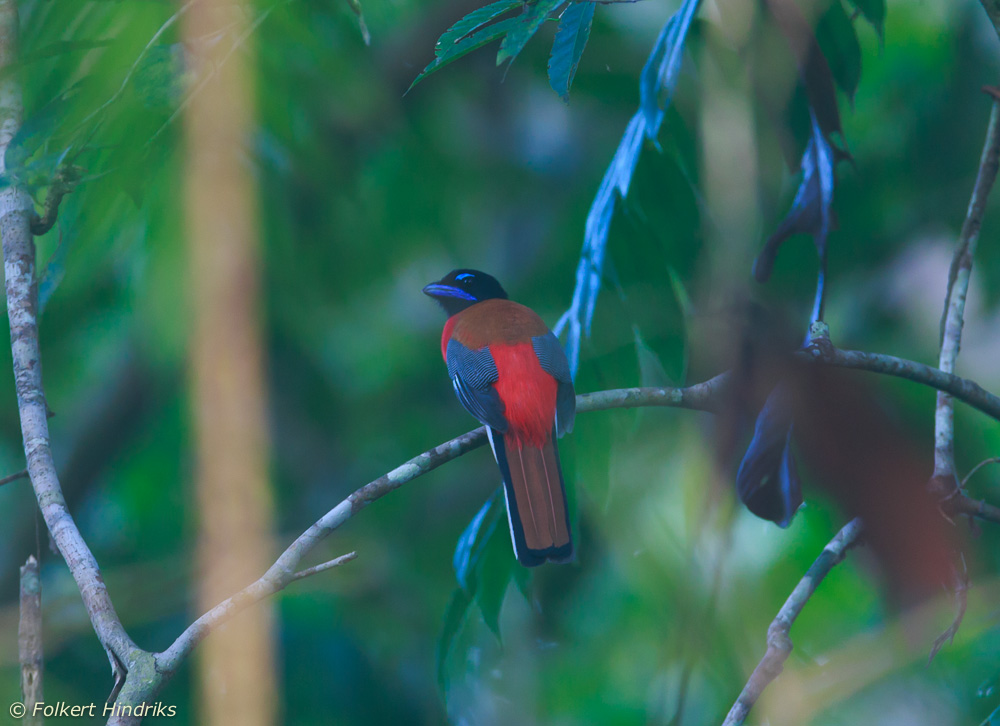
While waiting for the black-and-white bulbul to return, I heard a scarlet-rumped trogon singing and soon found the source.
Scarlet-rumped trogon (Harpactes duvaucelii).
I don't think I will ever tire of seeing a trogon, they really are stunning animals. There were also several black-winged flycatcher-shrikes around. This is one of the more common birds along KB road.
Black-winged flycatcher-shrike (Hemipus hirundinaceus).
Black-winged flycatcher-shrike (Hemipus hirundinaceus).
Two black magpies were making a lot of noise nearby. This is only the second time I have seen this species now on KB road.
Bornean black magpie (Platysmurus aterrimus).
This pygmy squirrel also showed quite well. These tiny squirrels do not measure more than 10 cm. I think this is the plain or least pygmy squirrel, and a from a little googling I just learned that this species is endemic to Borneo.
Least pygmy squirrel (Exilisciurus exilis).
After a while another black-and-white bulbul showed up, a female this time. This species really seems to have a cunning ability to make any photographing attempts difficult. In this one the head is superbly hidden behind a leave...
Female black-and-white bulbul (Pycnonotus melanoleucus).
The browner color suggest that this is a female. And here she is flying of again....
Female black-and-white bulbul (Pycnonotus melanoleucus).
The black-and-white bulbul is uncommon species. KB road seems to be a relatively good area for an encounter with this distinctive bulbul and I have seen them now on several occasions. This Saturday I was lucky to not only see a male and female bird, but also this juvenile.
Juvenile black-and-white bulbul (Pycnonotus melanoleucus).
 Finally the female showed up again and allowed some better shots.

And just in time as I really couldn't stay any longer; the jazz festival in Miri was waiting, which btw was very excellent!

Folkert, 13/05/2013.

Friday, 3 May 2013

Owling

Every so often we go on a little night drive around the area to look for owls, and any- and everything else active after dark. Buffy fish-owls are the commonest owl encountered. Most other nocturnal species seem to occur only in low numbers. There is however a good species diversity and there is always a chance to encounter something special.

When we went on a short night drive last Thursday we had two great finds. The first owl we picked up was an Oriental bay owl. After listening to the distinctive calls from two individuals for a good 20 minutes one of the owls finally showed itself.
Oriental bay-owl (Phodilus badius).
This is a tricky species to see and it was definitely a good feeling to finally get a visual of this beautiful little owl.

The evening had more in store! A kilometer or so down the road we picked up two reddish scops owls in duet across the road. And we soon located out this little fellow.
Reddish scops-owl (Otus rufescens).
Another little owl that is rarely seen. While this species is more often heard than the oriental bay owl, I have only had one very frustrating little glimpse before last nights encounter. No Buffy fish-owls this evening, but its two smaller cousins more than compensated!

Folkert, 04/05/2013.

Wednesday, 1 May 2013

Labi road, April 20th

Sunday a week ago Kolbjorn and I went to Labi road to check out a locality that I hadn't been to in ages. Lady luck was not with us this morning; almost as soon we had parked the sky opened its floodgates and the downpour quickly forced us back in the car. Rather than waiting it out we decided to head back to the main road, with some idle optimism that conditions would be better there.

A big fruiting tree along to the main road provided a perfect shelter for seemingly all barbets in the area and I had good views of blue-eared, red-throated and red-crowned. As soon as the rain stopped though a group of glossy starlings flew in and almost immediately claimed exclusive rights to the fruits. Only a couple of very persistent blue-eared barbets stayed around. This is a very common species and their incessant calls can be heard almost anywhere. I have never gotten a clean shot though!
Blue-eared barbet (Megalaima australis).
We stayed while the sky cleared up, secretly hoping the more exotic species would return to the tree. They didn't. A couple of tree-sparrows offered some distraction as they were peeping through a fence next to my car. The first breeding records of this species in Borneo only date back to the early 1960's - now it's a common bird just about everywhere humans live and work.
Eurasian tree-sparrow (Passer montanis).
After 20 minutes we gave up and headed back to the first locality. The first bird we noticed was this dark-sided flycatcher. I was a little unsure about the ID, so thanks to Dave and Wong for helping out!
Dark-sided flycatcher (Muscicapa sibirica).
Same bird: dark-sided flycatcher (Muscicapa sibirica).
A chestnut-bellied malkoha also showed reasonably well while it was creeping through the trees. Labi seems a good area for this generally uncommon species.
Chestnut-bellied malkoha (Phaenicophaeus sumatranus).
We soon noticed this second flycatcher, another dark-sided. I find the ID of this bird more straight forward, especially since the diagnostic grey spots below the vent are a lot clearer.
Dark-sided flycatcher (Muscicapa sibirica).
By now it was getting late in the morning and although we heard and saw some interesting species, the activity was rapidly slowing down. Labi-road still had one good surprise on the way back. Just before turning onto the highway back to Panaga a very large bird flew overhead: a Lesser adjutant!
Lesser adjutant (Leptoptilos javanicus).
In the past, this species was still seen on occasion in and around the Seria grasslands close to Panaga. The last record however dates far back to 2009 and sadly seems to be in line with the decline of this species. Due to primarily hunting pressure the Lesser adjutant is listed as vulnerable by the IUCN.

It's always nice to end a morning out with a good species; needless to say that I was very pleased to finally add this species to my Brunei list!

Folkert, 01/05/2013

Monday, 22 April 2013

Migrants in the Seria grasslands, April 2013

The Seria grasslands around Panaga form a good wintering ground for many waders and it pays off to drive around here as something interesting can almost always be seen. Even in April you can still spot a fair number of migrant birds on the fields and in the ditches surrounding these.
Snipe are typically not easily encountered as they are exceptionally well camouflaged. Most views are of birds flying of from a foot in front of you, leaving you wondering how you could have possibly missed it before it took to the sky. And when you then do finally see them getting a positive ID is also not straight forward.
The bird below was providing me with a brief and clear view; a possible Swinhoe's or Pintail snipe.
Snipe species
This grey heron was see sitting on a lamp post next to the main road connecting the cities of Kuala Belait and Seria. The grey heron is an uncommon visitor to Brunei, though every winter a few birds are usually seen. The Tutong sewage works in Brunei especially are a good place to find them. 
Grey heron
Even though it was drizzling and lighting conditions were far from perfect I somehow felt compelled to get this bird on camera - and am still questioning myself why: it seems rather strange to fill your memory card with pictures of a bird that is one of the very common sights back in Holland. 

A little later I found a flock of pacific golden plovers in the grasslands, nicely coming into breeding plumage - perhaps I may still get lucky and find some birds in full breeding plumage before they've all headed up north.
Pacific golden plover (Pluvialis fulva).
The pond herons are also still around - I suspect that the below individual is a chinese pond heron; but until the breeding plumage is developed further I can't fully rule out that this bird is a javan pond heron.
Chines pond heron (Ardeola bacchus).
The most familiar migrants to the Seria grasslands are the egrets. Every year between September and May the Sungai Seria estuary and surrounding grasslands are home to a couple of thousand birds. Of the white egrets that winter here, the cattle egret is the most common. Right now the adult birds are also coming into breeding plumage - with the distinctive orange head and plumes on the back.
Cattle egret (Bubulcus ibis).
This individual was vigorously defending a little wet patch that was created after extensive morning rains. I noticed some other birds doing the same.
Cattle egret (Bubulcus ibis).
The bird would become quite aggressive every time other birds came too close. Others egrets seemed more relaxed and just used the water-logged field to simply lie down in.
Cattle egret (Bubulcus ibis).
While driving back home through the grasslands this Sunday, like in October, I saw another small falcon flying fast across the road. Frustratingly I again couldn't get good enough views for a positive ID. As Kolbjorn got the same frustrating glimpse from the passenger seat at least this time the frustration was shared.

Folkert, 22/04/2013

Wednesday, 10 April 2013

The carpark woodpecker

A very brief post to share 2 recent pictures of a brown-capped woodpecker, also known as the Sunda pygmy woodpecker, Dendrocopus moluccensis.

This is a supposedly common woodpecker in coastal forest and gardens throughout Borneo. I, however, seem to mostly encounter this species in any large car park. In fact, the number of times that I have seen these birds in a different environment can probably be counted on one hand.

Our office car park is home to a couple of these chirpy little woodpeckers also and quite regularly they are seen and heard as they make their daily rounds. In recent years I have been very good at resisting the temptation to bring my camera to work - but when a little family group of 3 were seen up-close on consecutive mornings, I finally gave in. And, during the lunch-break I was rewarded with the following shots of the female.
Sunda pygmy woodpecker (Dendrocopus moluccensis). 
Sunda pygmy woodpecker (Dendrocopus moluccensis). 
Oh, and my stealth must be improving; none of my co-workers seems to have noticed me trodding through the car park, lens in hand...

Folkert, 10/04/2013.