Note - in some browsers the appearance of the blog is corrupted. I do not yet know the cause, but hope this issue will be resolved soon!

Tuesday, 7 October 2014

Godwits

This Monday was one of Godwits.

The day started off well with this flycatcher that I noticed sallying from one of the trees in our garden during breakfast. Almost an exact repeat from October last year, see garden flycatcher.
Dark-sided flycatcher (Muscicapa sibirica)
We were having a day off and I took the opportunity to drive around some of the remoter areas of Brunei. First though was a stop at the very familiar grasslands surrounding Seria. This very skittish black-tailed godwit was foraging in one of the grassy pools.
Black-tailed godwit (Limosa limosa)
This was in fact the very first godwit ever seen by me! Next we drove on to Wasan rice fields, where numerous rarities have been recorded in the past. The first birds we saw were, waddaya know, another 4 godwits!
Black-tailed godwit (Limosa limosa)
Apart from the godwits Wasan didn't turn up anything special. Kolbjorn counted around 260 whistling ducks (I was too lazy to count with him) and there where good numbers of wood sandpiper and long-toed stints. Other notable birds seen where snipe, yellow- and cinnamon bittern, black-winged stilts and a lone greenshank. Noticeably absent were any raptors. We did see and hear some warblers whizzing by on a few occasions but never had prolonged views to nail the ID.

On the way back we saw this blue-necked keelback on the road. The snake was kind enough to stay with us for a few pictures.
Blue-necked keelback (Macrophistodon rhodomelas)
A very pretty snake to end a good day with!

Folkert 07/10/2014

Saturday, 4 October 2014

Oriental Plover

I decided this afternoon to do some easy birding as I haven't been feeling the best lately. So rather than go on a jungle walk I took out the car for a drive around the grassy areas behind the seawall.

To my surprise there were two oriental plovers on the pitch next to the clinic. Not only a great find for Panaga, but also a lifer for me. I suspect one of the birds to be a juvenile, the other an adult loosing its breeding plumage.

The second rarity drove up to my car ten minutes later, a fellow birder in the name of Kolbjorn. In my 5 years in Brunei I have never met another birder unplanned in the field; there clearly is a first for everything. We spend a good amount of time to get a photo of the plovers. There was still some distance to overcome, but in the end I did manage to get some keeper shots.
Oriental plover (Charadrius veredus)
Not bad for a casual drive on a leisurely Saturday afternoon.

Folkert, 04/10/2014

Monday, 29 September 2014

Aarrgh!

Last week, Kolbjorn and myself went for an evening walk on one of the more remote sidetracks of Labi road. We arrived shortly before dusk and walked a good distance before the sun was fully set. The area that we walked through is mostly peat swamp and the track had a nice stream next to it with a deep rusty brown color from all the leaching tannins. The walk was livened up by the sounds of two rhinoceros hornbills deep into a domestic dispute, a great slaty woodpecker and some very skittish red langurs.
The real reason we were there was to search for some night birds. We had just turned from the furthest point when we heard a very distinctive call close by, one that I couldn't straight away place. A search on the iPhone quickly revealed the culprit: a Gould's frogmouth. And not just one, but two birds. I still don't know how we managed it, but we somehow completely messed up this opportunity and never got a visual. The birds fell silent very soon and were only heard very distantly afterwards. Maybe the playback we used was akin to a serenading cat, whatever it was we never saw a glimpse.

It goes without saying we felt a little defeated, but at the same time also very elated; we only just had started the walk back and with a start like this the remainder of the walk surely would be brilliant. So, in way, it wasn't a total surprise that we got a response from a barred eagle owl less than 200 meters later! First one and a little later a second one. We managed this time to record the two birds duetting, but again, no visuals! One owl even flew over our head, but picked a branch just facing away from us, and the dense undergrowth prevented us to walk in. We spend close to an hour trying to get a view, but to no avail; the birds wouldn't give themselves up.

Luckily this Harlequin tree frog, that we found a little further down the track, was more cooperative and didn't object at all to take center stage. In fact, every time it jumped it seemed to end up in an even better photographic position.
Harlequin tree frog (Rhacophorus pardalis)
Supposedly this is a common species, though that does't mean I see it very often. I fact, I actually can only recall to have seen it in Danum before.
Harlequin tree frog (Rhacophorus pardalis)
Just before we reached the car we stumbled upon this spiny turtle. My knowledge of turtles isn't that great and I didn't realize at the time that this is actually rapidly becoming a very rare species. The IUCN lists this turtle as endangered, as unfortunately these animals still end up way too often on dining plates and in soup bowls somewhere in SE Asia.
Spiny turtle (Heosemys spinosa)
The population in Brunei is still considered as relatively stable, though if I were this little fellow I wouldn't stray off into more populated areas.
Spiny turtle (Heosemys spinosa
And, since this still is a blog about birds, I'll end this post with some shots of the birds I got on camera the last two weeks. A collared kingfisher; while these are very common around Panaga, they're actually not that approachable and unplanned close-up opportunities are not common. This one was sitting on the fence of a beam pump.
Collared kingfisher (Todiramphus chloris)
While on my way to Bandar I briefly stopped at Wasan rice fields. There were quite a few black-winged stilts around.
Black-winged stilt (Himantopus himantopus)
And a couple of white-winged black terns.
White-winged black tern (Chlidonias leucopterus)
And finally, a superb record from Brunei. Recently a second photographic record of the spectacled flowerpecker was made in Labi hills by local photographer Mr. Asmali Asli. See also:

http://www.borneobirdimages.com/news?id=56
http://www.sabahmagazine.com/spectacled-flowerpecker-second-photographic-record/

This species was only discovered in Danum in 2009 and it is therefore truly excellent to have the second encounter in Brunei. Moreover the pictures are fantastic! I have been at Labi ridge numerous times and never had the luck to find a species with this type of allure there. In a way I am almost glad to leave Brunei so I won't be able to give in to obsessive, and more than likely unsuccessful, chases of this very elusive species.

Folkert, 29/09/2014

Saturday, 13 September 2014

Panaga and surroundings, 2nd week of September

Last weekend we ventured to the Baram delta. For anyone who wants to follow suit a word of advice: do not go at high tide!!! Hardly any exposed beach and we didn't see much… the trip would have been a complete waste of time if it wasn't for some distant greater crested terns (a Bornean lifer for me) and the good tidal lesson. Perhaps I'll have another attempt next week.

Closer to home migration is in full swing and small groups of red-necked stints can be found frequently on the beach.
Red-necked stint (Calidris ruficollis)
This bird was one of a small group foraging in the late afternoon.
Red-necked stint (Calidris ruficollis)
Their close relatives, the long-toed stints, can be found in the small creeks, puddles and pools of the coastal grasslands
Long-toed stint (Calidris subminuta)
Long-toed stint (Calidris subminuta)
While on my way home from lunch this week I noticed a lesser adjutant circling over the grasslands. Luckily I had a camera in the car to record the encounter. I saw it landing behind the trees lining the river edge of the Sungai Seria, but work duties prevented me from seeking out the bird.
Lesser adjutant (Leptoptilos javanicus)
The last confirmed sighting from Seria dates back to 2009 - so this is quite a good record. The next day I tried to see if the bird was still around. My search along the river edge only turned up this crocodile.
Crocodile
This morning I spend a short hour at Badas. I did see a couple of birds, o.a. grey-chested jungle flycatcher and the customary hook-billed bulbul. From a photographic perspective it wasn't the most productive hour; I failed to get a single bird on camera. The only picture I had when I walked out the forest was of this butterfly...
Butterfly
This woodswallow that had perched just above my car offered some small solace. Often overlooked, like many of the more ordinary birds, they are really quite handsome.
White-breasted woodswallow (Artamus leucorhynchus)
Folkert, 13/09/2014

Sunday, 31 August 2014

Sungai Seria, end of August

I've been checking the river mouth of the Seria river the past 2 weeks, as this is the time when most waders pass by. Usually a couple of sand plovers are around and with high tide they can come sufficiently close for some nice pictures. Here is one resting on a single leg:
Lesser sand plover (Charadrius mongolus).
And this bird rather doesn't use any legs at all.
Lesser sand plover (Charadrius mongolus).
This is also a good time to see sanderlings. Even on their way south, these are very active feeders, constantly running on the shoreline looking for little morsels.
Sanderling (Calidris alba).
Their dutch name is "drieteen strand loper", which means as much as three-toes sandpiper. An adequate description; sanderlings miss a fourth hind toe as can be seen in the picture below.
Sanderling (Calidris alba).
August and September are also good months to spot terns on the sandy shores next to the estuary. Mostly the flocks consist of little terns, which is a breeding species in Brunei.
Little and common terns
But now and again some other tern species join their smaller cousins, such as these common terns.
Common tern (Sterna hirundo).
The gull-billed terns are a size bigger and easily spotted. They're not always around and never numerous, typically just one or two birds. This bird is still in breeding plumage.
Gull-billed tern (Gelochelidon nilotica).
 I think this bird is already loosing its breeding plumage.
Gull-billed tern (Gelochelidon nilotica).
Whimbrels are never seen in large numbers here. This was one of three birds, that flew in only for a very short period. Here it is taking off on its way further south.
Whimbrel (Numenius phaeopus).
The grass lands are getting a little busier too. The number of egrets is clearly on the rise and little ringed plovers can be seen here and there. A few golden plovers were seen foraging just behind the beach wall in the shallow grassy pools.
Pacific golden plover (Pluvialis fulva).
The last pic is not of a migrant, but of a thinly scattered forest species: a young male scarlet-breasted flowerpecker. I bumped into this bird in the weekend and I think this is my best shot of this species (or at least the sharpest…) so far.
Scarlet-breasted flowerpecker (Dicaeum thoracicus).
I am possibly planning a small recce to the Baram estuary this week or next, which should be a good location for some additional waders.

Folkert, 31/08/2014

Wednesday, 20 August 2014

Updates from Panaga

I haven't been posting a lot on this blog this year. The fact of the matter is that I have still been out a few times, but just haven't found the time to document it here.  So, without ado…here are some brief highlights of the last few weeks. 

Mid July I spend a couple of early morning hours in the Badas area. First time that I came across a small bird wave there. In its wake I heard and spotted this male green broadbill. 
Green broadbill (Calyptomena viridis)
Obviously a nice encounter as this is a stunning species. What's more, this was also the first time I encountered a green broadbill in the peat swamp forest, so not a bad record either.

The most prominent species in the bird wave were some drongo's, two different malkoha species and a pair of crimson-winged woodpeckers. A couple of scaly-crowned babblers also passed close by.
Scaly-crowned babbler (Malacopteron cinereum)
And the wave wouldn't be complete without a couple of hook-billed bulbuls, this is after all a peat swamp area. I am still hoping to get that killer shot one day...
Hook-billed bulbul (Setornis criniger)
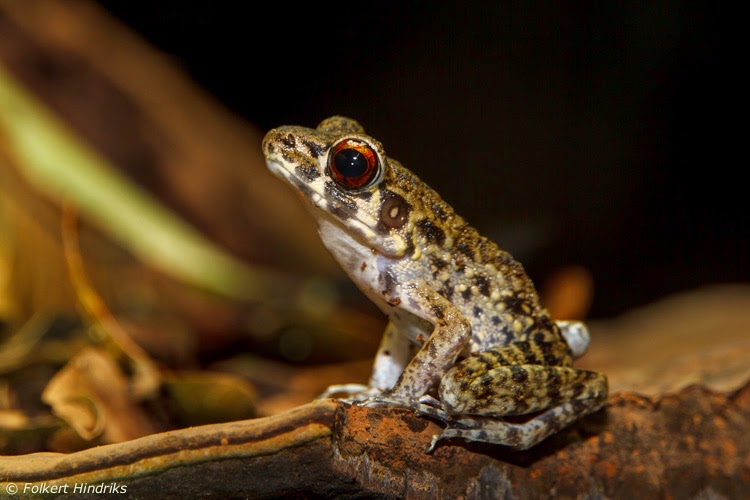
Another highlight was an evening walk through the Teraja forest last week. We walked in late afternoon and walked back when darkness had fully set in. The real aim was to record some night birds. Of course we didn't hear a single owl, nightjar or frogmouth (the real target) on the way back, but the walk was still excellent. It is always a special feeling to walk in perfect darkness surrounded by all the sounds of the forest. We still managed to see some animal life, like this rough-sided frog, a common lowland species.
Rough-sided frog (Hylarana glandulosa)
We also came across a stunning huntsman spider. Not sure if these awesome colors serve a specific purpose, but I did know that I wasn't going to pick it up!
Huntsman spider sp.
A pair of bright eyes in the canopy proved to be a black flying squirrel. Only the second time I've ever seen this species.
Black flying squirrel (Aeromys tephromelas)
Finally, the migration season has started in earnest. I had a spare hour last Sunday after lunch and decided to try for some pictures of the terns that can typically be seen close to the shore this time of year. While looking for the terns a flock of mixed waders landed right in between some foraging plovers. I was quite pleased to see 3 curlew sandpipers.
Curlew sandpiper (Calidris ferruginea)
The curlew sandpipers were joined by close to 10 terek sandpipers, which is a species that is not often recorded on the beaches close to Panaga.
Terek sandpiper (Xenus cinerea)
The plovers were also showing well. Here is a greater sand plover.
Greater sand plover (Charadrius leschenaultii)
And here 2 lesser sand plovers.
Lesser sand plover (Charadrius mongolus)
In addition to species shown here I also saw red-necked stints, redshank, golden plovers and numerous common sandpipers and wood sandpipers in the coastal grasses and mudflats. 

A final update is that I recently learned that my time in Brunei is coming to an end. End October we will move on to our next location in the United States. Still a few weeks to reach the magic 400 species in Borneo - I'll either need a good dose of luck in Brunei or another venture across the border!

Folkert, 19/08/2014

Thursday, 3 July 2014

Badas again

The Badas area is one of my favorite spots in Brunei. It is mostly prime peat swamp forest with some smaller areas of Kerangas. One plus point is that it is close to home. The other is that the area hides some type specialists that are hard to find elsewhere, examples are hook-billed bulbul, bristlehead, grey-breasted babbler and cinnamon-headed green pigeon.

Besides these specialists the species diversity is relatively large, abundance however not so much. Especially in the forest itself birding can put a real test to your patience. What's more, when you do finally get to see a bird it will typically do anything in its power to ensure that you will not leave with a good picture.

A small group of dusky broadbills I saw recently pretty much stuck to the canopy. Of course, when one of the birds decided to come down it chose the only branch directly overhead.
Dusky broadbill (Corydon sumatranus)
Due to the habit of rarely perching still for more than a few seconds flowerpeckers are not the easiest birds to get on camera under any circumstance. But this rare brown-backed flowerpecker also valued a rather large personal space and for 20 minutes I was chasing only brief glimpses after which it left the scene completely; these heavy crops are the best material I ended up with.
Brown-backed flowerpecker (Dicaeum Everetti)
Brown-backed flowerpecker (Dicaeum Everetti)
To offset this frequent frustration there are of course also the more satisfying sightings. I think someone wise once mentioned that the best sighting for a birder is a mammal (… or reptile in this case). I don't believe that is entirely true, but a second sighting of this Malaysian brown snake last weekend on the Badas road came pretty close.
Malaysian brown snake (Xenelaphis Hexagonotus)
I had seen this species once before on KB road and the picture I then managed even made it to the second edition of the Snakes of Borneo field guide by Robert Stuebing et. al. that was launched recently. Supposedly good pictures of this snake are hard to come by - this part of Brunei seems to be the exception to the rule.

Folkert, 03/07/2014