Note - in some browsers the appearance of the blog is corrupted. I do not yet know the cause, but hope this issue will be resolved soon!

Monday, 22 July 2013

Temburong

This weekend I treated my mom -who is visiting again- and myself to a small overnight trip to the Ulu Ulu resort in Temburong, the "other" part of Brunei. Temburong is only a short 2 hour journey from Bandar; a simple hop on a fast ferry to Bangar, followed by a small bus ride and another 30 minutes upstream by longboat and you'll find yourself surrounded by pristine jungle.

The last time I visited Temburong was well over 2 years ago and especially the canopy proved very rewarding then; a lot of species allowed very close views, like this velvet fronted nuthatch.
Velvet-fronted nuthatch (Sitta frontalis).
We arrived in Temburong around 4:30 PM and I spend the last hour or so of daylight around the resort. The white-rumped shama was impossible to miss.
White-rumped shama (Copsychus malabaricus).
During the evening we joined a short night walk up a tiny stream from the main river. 17 people on a night walk is really too crowded and I didn't have high expectations to encounter a lot of wildlife. Still I enjoyed this, as the stream proved a good place for frogs and I got a couple a great close-ups. As I am definitely not a frog specialist any correction/addition to my ID's are appreciated. I suspect the tiny fellow pictured below to be a Microhyla species.
Microhyla sp.
I think this is Hylarana megalonesa.
Hylarana megalonesa
The below frog is definitely a horned frog species!
Bornean horned frog (Megophrys nasuta).
The next morning we got up very early to be in time for sunrise at the canopy walk. Nowadays, you can only get to the start of the trail to the canopy by boat as the bridge crossing the river is in dire need of some repairs. After a half hour walk, scaling 290 meters elevation to the base and another 40+ meters to the canopy itself, you are rewarded with a wide 360 degree view over the awaking jungle. The rising fog and the morning calls of gibbons makes this almost perfect - next time I'll bring some warm coffee for a nice finishing touch!
Canopy walkway & tower, Temburong.
I spend a little over two-and-a-half hours at the canopy walk way listening to the gibbons and recording several different birds. This male black-and-yellow broadbill was seen and heard most of the time.
Black-and-yellow broadbill
A spectacled bulbul also provided some good views. Even though this is a supposedly common species of all primary forests type in Borneo, I don't see them that often closer to home and was therefore quite pleased with this individual checking me out at close range.
Spectacled bulbul (Pycnonotus erythropthalmus).
Besides the gibbons, the calls of both rhinoceros and helmeted hornbill seemed equally far carrying. A family of 4 rhinoceros hornbills flew by over the canopy, adding to the majestic scenery with the morning fog rising through the forest. One parent lead the way.
Rhinoceros hornbill (Buceros rhinoceros).
 And was eagerly followed by two juveniles
Rhinoceros hornbill (Buceros rhinoceros).
At 08:30 we decided to move down and try for some birds lower to the ground. I had expected to see and hear more babblers, but the only ones I picked up were chestnut-winged babblers, which seemed to be everywhere, and a small family group of scaly-crowned babblers.
Scaly-crowned babbler (Malacopteron cinereum).
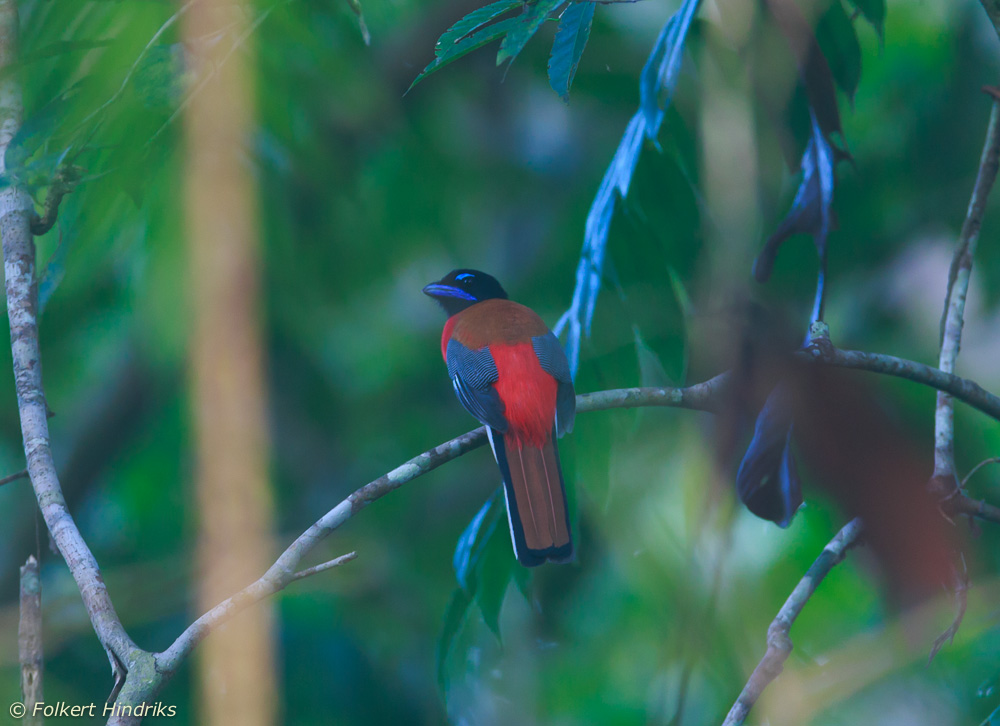
An incessantly calling diard's trogon was already heard from the canopy-walk and at least 2 different males and one female were seen on the relatively short walk from the tower back to the river.
Male Diard's trogon (Harpactes diardii).
As my mom had not joined the trip to the canopy walk because of a weak knee I felt some social obligation to not stay out all morning and returned back to the resort close to 10 AM. Together we walked around the resort grounds looking for some resident wildlife. Fruitbats were easily seen overhead at the wooden boardwalks. I think this is the Sunda short-nosed fruit bat (Cynopteros brachyotis).
Fruitbat sp.
Flowering bushes close to the river were a good spot for both leafbirds and sunbirds. 
Male Lesser green leafbird (Chloropsis cyanopogon).
A nice surprise was this yellow-breasted flowerpecker. Just a small bummer that I failed to get a proper photo. Oh well.
Yellow-breasted flowerpecker (Prionochilus macalatus).
Just before heading back to Bandar this very bold pygmy squirrel seemed completely unbothered by our presence and I even had to stand back to get the animal properly into frame!
Plain pygmy squirrel (Exilisciurus exilis).
Around 1:30 PM we left again, back to Panaga. A great little trip and I am certain that with a little more dedicated effort some great species can be picked up in Temburong!

Folkert, 21/07/2013

Tuesday, 16 July 2013

Pelong Rocks

A quick summary of a weekend morning spend on the water for a change. I recently got invited to join a little snorkeling trip to Pelong rocks. As most of my forays are into the jungle, this was also a great opportunity to test the waters for some pelagic species. We met up with everyone in Muara and were introduced to our friendly hosts of the day: Nad and Sean, two local divers (and, as someone nicely put it, a real power couple!).
Tug boats in the harbor of Muara.
En route to Pelong rocks we noticed this wreck in the distance and innocently informed with Sean if he ever had dived there. He had not, the main reason being that this was the first time he saw this wreck! And indeed we were soon informed by another boat that the ship had only run to ground during the previous night. Luckily the crew of 11 got of unscathed.
A very recent wreck!
Back to Pelong rocks. Pelong rocks is a small rocky formation roughly 3 miles of the shore from Muara. The main outcrop has some trees on it, some of the other parts are completely bare. According to previous records both bridled and black-naped terns are known to breed on these rocks.
On the way to the rocks we did see terns, mostly bridled with an occasional black-naped tern. In the below picture a bridled tern is coming my way with part of Pelong rocks as the backdrop.
Bridled Tern, with Pelong Rocks in the background.
And a little closer.
Bridled Tern (Sterna anaethetus).
Terns seem to still be breeding on the rocky formations, though in small numbers only. We passed by the outcrops too fast & distant for a proper count, but I would estimate that around 25 birds where hanging about.
Bridled terns (Sterna anaethetus).
In front of the main island we got out to do some snorkeling. The water was clear and the snorkeling was absolutely great! I will definitely have to go here again to show some other Panaga uninitiated this spot.
Pelong rocks; main island.
I was thoroughly enjoying looking at all the fish, still I couldn't help myself to occasionally lift my gaze skyward. These gazes were quickly rewarded with views of about 10 pied imperial pigeons hiding in the foliage of the 4 bigger trees on the island.
Pied imperial pigeon (Ducula bicolor).
When the wind picked up we left Pelong rocks and moved to some of the fish farms and our BBQ destination. Along the way a lone little tern was seen and we also passed this beacon. Judging by the white smudges on the green paint this seems a favorite hangout of the black-naped terns.
Black-naped terns (Sterna sumatrana).
Finally a capture of our reliable transport, a custom build dive boat.
The dive boat
This was a very memorable day. Thanks to Guenter for inviting me along and a very big thanks to Nad and Sean for the perfect organization!

Folkert, 16/07/2013

Friday, 21 June 2013

Wetlands International surveys II

It's been a while since my last update. I have been rather busy with work and also was in Europe for 10 days, part work and part meeting up with friends. It felt good to be back in Europe for a while, it's hard to beat enjoying good food with old friends on a long summer evening.

The second dedicated bird surveys for the Wetlands International project started when I was away last week (for an introduction to the WI project, see a previous post: wetlands international survey). WI is doing an excellent job pulling in the experts: after Dennis Yong, this time Dave Bakewell is leading the bird surveys. Dave is one of the foremost bird experts in the region and hardly needs an introduction. If you have never visited his weblog than please do so at dig deep, a great read and teeming with useful information on bird identification.

Again I have again been lucky to be invited to help out. Last Thursday I joined one of the surveys, which was an excellent way to rid myself quickly of the jet lag. We met up in the early morning to explore the more remote areas of peat swamp and kerangas forests that are typical of the lower Belait district. On the way we saw a lesser adjutant, a good omen! At our first locality we had good, though slightly distant, views of a male scarlet-breasted flowerpecker. This is not an easy bird to find and I am very happy that I got a few shots of this splendid little bird!
Crimson-breasted flowerpecker (Prionochilus thoracicus).
There was plenty of other bird activity, though most was out of reach of my camera. Rare birds elsewhere, cinnamon-headed green pigeons are a relatively common sight in the open areas and we spotted several smaller flocks. A group of thick-billed green pigeons had joined the cinnamon-headeds in the tree pictured below, before flying of:
Cinnamon-headed green pigeons (Treron fulvicollis) and
 Thick-billed green pigeons (Treron curvirostra).

With Angus, Dave and Kolbjorn.
When we moved to the next locality we soon heard a species that has eluded me for the past 3 years: the hook-billed bulbul! This is a peat swamp specialist, and there is no surprise that it is found here. Pristine peat swamp forest is getting increasingly scarce on Borneo and with the rapid disappearance of suitable habitat this species is listed as threatened (vulnerable) by IUCN.
Hook-billed bulbul (Setornis criniger). 
And so I finally added this long awaited lifer to my Bruneian list. In the below picture the distinctive white tail tips can clearly be seen - most of the head is however well hidden behind a branch and I will definitely need to try for better photographs in the future!
Hook-billed bulbul (Setornis criniger).
We continued again at dusk with the aim to get Dave good pictures of the Bonaparte's nightjar. Around the Badas area literally thousands(!) of flying foxes can be observed as they fly over to their preferred fruiting spots. The flying fox is the largest flying mammal and it is a very surreal sight to see so many big bats flying overhead in an almost continuous stream, it delivers a vague sense of being part of the latest vampire movie.
These mass wanderings seem a recurring phenomenon, as I had witnessed it before in 2010 and I suspect they are related to temporary localized fruiting periods. With the dusk setting in I failed to capture a good impression of the full scale of the bats passing by, but I did get some shots of individuals flying over.
Large flying fox (Pteropus vampyrus).
Batman!
We did hear and see the nightjar, but the bird couldn't be tempted to show itself well enough for any pictures. While waiting for the nightjar a colugo soared by overhead, landing not too far away from us. These animals can truly glide, I estimate that this individual covered at least a 100 meters with a single jump/glide/flight.
Sunda flying lemur or Colugo (Galeopterus variegatus).
Note the little peeping Tom.
These trips into the more remote parts of the lower Belait seem to imply that some of the species typically associated with nutrient-deficient soil forests are especially sensitive to disturbance. While I have recorded some great birds in the past 3 years along the Kuala Balai road I have never seen hook-billed bulbul and scarlet-breasted flowerpecker there and only very rarely encounter cinnamon-headed green pigeons: one could hypothesize that the road and related activity has a clear negative effect on the presence of the aforementioned species. With the ever expanding human encroachment on nature the efforts of Wetlands International will be an important step towards building a sustainable future for the lower Belait forests. I am anxiously looking forward to the findings and recommendations of this project.

Folkert, 21/06/2013

Sunday, 19 May 2013

KB road, yet again.

A little feedback from the past week, starting with a morning trip to KB road this weekend. The morning was relatively productive, I even saw another black-and-white bulbul, but I have very little to show for. I did however manage to get some shots of the ruby-cheeked sunbird, which I consider to be my best so far. Here is the male:
Male Ruby-cheeked sunbird (Chalcoparia singalensis).
And again, now showing the origin of its name.
Male Ruby-cheeked sunbird (Chalcoparia singalensis).
At first I thought this pair was feeding, but soon realized that they were returning to the same branch because they were laying the foundation of their new home. Here is the female, carrying some nesting material.
Female Ruby-cheeked sunbird (Chalcoparia singalensis).
The only other bird picture I find worth showing is of this buff-rumped woodpecker that I found foraging in the trees. This small woodpecker is one of the more common woodpeckers seen. 
Buff-rumped woodpecker (Meiglyptes tristis).
When I drove home, I noticed a large group of silver leaf monkeys and watched them for a while from my car. The massive jumps they made from one tree to the next is really impressive. Here is one animal taking off.
Silver Langur (Trachypithecus cristatus).
The siliver langur, or silver(ed) leaf monkey is listed as near threatened by IUCN. Luckily they're still reasonably often encountered in Brunei. There is even one group in Panaga, which is very unique situation (see also an earlier post, my garden birds ii, August 2012).

As some of you may have discerned from previous posts, we also attempt to explore the fauna around Panaga during the evening hours. Last Thursday Kolbjorn, together with his two kids Hannah and Jonas, and myself went out for an evening drive on KB road.

This was the first time I drove down KB road during an evening shower. The low-hanging fog, that accompanies the rain while it evaporates on the still hot tarmac of the road, creates a very eerie atmosphere. With the amount of rain we quickly abandoned the idea of spotlighting and focused our attention mainly on the area in front of us that was illuminated by the car's headlights. And we soon found that we weren't the only ones: when I put on the breaks to avoid running over a little frog we were astonished to see a Buffy fish owl swooping down to pick it up, just two meters in front of us. What a sight! 
It quickly became apparent that the wet road becomes a preferred hunting ground for the Buffy fish-owls. We counted no less than 7 different birds - without the aid of any spotlighting! With their hunting accuracy any frog that crosses the road puts its life in serious danger.
Buffy fish-owl (Ketupa ketupu) in the rain.
On the way back it even got better when we spotted this Wagler's pit viper. This is one of the more common Bornean snakes. Adults get to about a meter in length, this youngster was only around 30 centimeters and still had stunning bright green colors. It is a true nocturnal species; they are very docile and sluggish during the day, often found motionless for hours on the same branch. Even though bites are rare, care should always be taken with these snakes, Wagler's pitviper is poisonous and its venom really packs a punch!
Juvenile Wagler's pitviper (Tropidolaemus wagleri).
The snake pictures were taken without flash and I am very pleased with the results; all the credit goes to Hannah though, without her perfect support holding the torch we would have nothing to show for. Thanks Hannah!

Folkert, 19/05/2013.

Monday, 13 May 2013

KB road in spring

I had planned to spend some of the morning hours at KB road on my Friday off. As it happened it was pouring down when I got up and I needed very little persuasion to return my head back to my pillow. Luckily, the weather promised to be much better the next day and at Saturday 6 AM I turned onto KB road in a highly upbeat mood.

Some bushes next to the road were fruiting and there were plenty of bulbuls around, mostly black-headed, but I also saw a puff-backed bulbul which is an uncommon encounter at KB road. After a couple of minutes the star of the morning flew in: a male black-and-white bulbul.
Male black-and-white bulbul (Pycnonotus melanoleucus).
This first picture is really not very good. I was shooting against the light with a slightly fogged up lens. And not only that, I also still had my camera in a fixed setting from the previous night! Not very smart. It's hard to explain the anguish when failing to make the most of a perfect photo opportunity of a hard to get bird.

While waiting for the black-and-white bulbul to return, I heard a scarlet-rumped trogon singing and soon found the source.
Scarlet-rumped trogon (Harpactes duvaucelii).
I don't think I will ever tire of seeing a trogon, they really are stunning animals. There were also several black-winged flycatcher-shrikes around. This is one of the more common birds along KB road.
Black-winged flycatcher-shrike (Hemipus hirundinaceus).
Black-winged flycatcher-shrike (Hemipus hirundinaceus).
Two black magpies were making a lot of noise nearby. This is only the second time I have seen this species now on KB road.
Bornean black magpie (Platysmurus aterrimus).
This pygmy squirrel also showed quite well. These tiny squirrels do not measure more than 10 cm. I think this is the plain or least pygmy squirrel, and a from a little googling I just learned that this species is endemic to Borneo.
Least pygmy squirrel (Exilisciurus exilis).
After a while another black-and-white bulbul showed up, a female this time. This species really seems to have a cunning ability to make any photographing attempts difficult. In this one the head is superbly hidden behind a leave...
Female black-and-white bulbul (Pycnonotus melanoleucus).
The browner color suggest that this is a female. And here she is flying of again....
Female black-and-white bulbul (Pycnonotus melanoleucus).
The black-and-white bulbul is uncommon species. KB road seems to be a relatively good area for an encounter with this distinctive bulbul and I have seen them now on several occasions. This Saturday I was lucky to not only see a male and female bird, but also this juvenile.
Juvenile black-and-white bulbul (Pycnonotus melanoleucus).
 Finally the female showed up again and allowed some better shots.

And just in time as I really couldn't stay any longer; the jazz festival in Miri was waiting, which btw was very excellent!

Folkert, 13/05/2013.

Friday, 3 May 2013

Owling

Every so often we go on a little night drive around the area to look for owls, and any- and everything else active after dark. Buffy fish-owls are the commonest owl encountered. Most other nocturnal species seem to occur only in low numbers. There is however a good species diversity and there is always a chance to encounter something special.

When we went on a short night drive last Thursday we had two great finds. The first owl we picked up was an Oriental bay owl. After listening to the distinctive calls from two individuals for a good 20 minutes one of the owls finally showed itself.
Oriental bay-owl (Phodilus badius).
This is a tricky species to see and it was definitely a good feeling to finally get a visual of this beautiful little owl.

The evening had more in store! A kilometer or so down the road we picked up two reddish scops owls in duet across the road. And we soon located out this little fellow.
Reddish scops-owl (Otus rufescens).
Another little owl that is rarely seen. While this species is more often heard than the oriental bay owl, I have only had one very frustrating little glimpse before last nights encounter. No Buffy fish-owls this evening, but its two smaller cousins more than compensated!

Folkert, 04/05/2013.

Wednesday, 1 May 2013

Labi road, April 20th

Sunday a week ago Kolbjorn and I went to Labi road to check out a locality that I hadn't been to in ages. Lady luck was not with us this morning; almost as soon we had parked the sky opened its floodgates and the downpour quickly forced us back in the car. Rather than waiting it out we decided to head back to the main road, with some idle optimism that conditions would be better there.

A big fruiting tree along to the main road provided a perfect shelter for seemingly all barbets in the area and I had good views of blue-eared, red-throated and red-crowned. As soon as the rain stopped though a group of glossy starlings flew in and almost immediately claimed exclusive rights to the fruits. Only a couple of very persistent blue-eared barbets stayed around. This is a very common species and their incessant calls can be heard almost anywhere. I have never gotten a clean shot though!
Blue-eared barbet (Megalaima australis).
We stayed while the sky cleared up, secretly hoping the more exotic species would return to the tree. They didn't. A couple of tree-sparrows offered some distraction as they were peeping through a fence next to my car. The first breeding records of this species in Borneo only date back to the early 1960's - now it's a common bird just about everywhere humans live and work.
Eurasian tree-sparrow (Passer montanis).
After 20 minutes we gave up and headed back to the first locality. The first bird we noticed was this dark-sided flycatcher. I was a little unsure about the ID, so thanks to Dave and Wong for helping out!
Dark-sided flycatcher (Muscicapa sibirica).
Same bird: dark-sided flycatcher (Muscicapa sibirica).
A chestnut-bellied malkoha also showed reasonably well while it was creeping through the trees. Labi seems a good area for this generally uncommon species.
Chestnut-bellied malkoha (Phaenicophaeus sumatranus).
We soon noticed this second flycatcher, another dark-sided. I find the ID of this bird more straight forward, especially since the diagnostic grey spots below the vent are a lot clearer.
Dark-sided flycatcher (Muscicapa sibirica).
By now it was getting late in the morning and although we heard and saw some interesting species, the activity was rapidly slowing down. Labi-road still had one good surprise on the way back. Just before turning onto the highway back to Panaga a very large bird flew overhead: a Lesser adjutant!
Lesser adjutant (Leptoptilos javanicus).
In the past, this species was still seen on occasion in and around the Seria grasslands close to Panaga. The last record however dates far back to 2009 and sadly seems to be in line with the decline of this species. Due to primarily hunting pressure the Lesser adjutant is listed as vulnerable by the IUCN.

It's always nice to end a morning out with a good species; needless to say that I was very pleased to finally add this species to my Brunei list!

Folkert, 01/05/2013