Note - in some browsers the appearance of the blog is corrupted. I do not yet know the cause, but hope this issue will be resolved soon!

Sunday, 20 January 2013

Panaga and KB road, 19-01

A quick recap of my weekend's birding and photography attempts. I'll start with this morning when I went for a short trip to KB road. With great weather, the whole morning was a little slow going. There was definitely a lot of activity, most of it was however well outside the reach of my bins and camera. I assumed the loud crashing sounds coming from the ditch were announcing a bearded pig and I cautiously moved back a little. I was quite surprised to see this little fellow pop up from the long grass, as the cause of all the ruckus.
Yellow-throated marten (Martes flavigula ssp. saba).
The looks are a little deceiving. While the yellow-throated marten scores high on cuteness, this is a ferocious little carnivore. These animals are widespread in Asia, the martens in Borneo are a separate subspecies: Martes flavigula ssp. saba.
Yellow-throated marten (Martes flavigula ssp. saba).
I am very happy with these shots. For a first time encounter you can't ask for any better posing!

The rest of the morning was uneventful. A rufous-bellied hawk eagle was noteworthy, unfortunately it was a little too distant for anything better than some simple record shots.
Rufous-bellied hawk eagle (Lophotriorchis kienerii).
Surprisingly, on my way back I again saw two red-billed malkohas. After not having encountered these birds on the KB road for 2 years, they are now rapidly establishing themselves as one of the regulars!

A second trip with my camera was yesterday evening, when Kolbjorn and I went for a short night drive along the Panaga coastal road "hunting" for owls and nightjars. The grassland just behind the beach is a good spot for nightjars and we saw at least 6 different individuals (the 6th sitting in the middle of the road on our way back). We were secretly hoping for some more exotic species than large-tailed's but not this night. Below 3 different birds:
Large-tailed nightjar (Caprimulgus macrurus).
Not bad at all for a quick drive down the road! Planning for another night drive to KB road this week.    More on that later.

Folkert, 20/01/2013 

Saturday, 12 January 2013

Panaga garden chases

This week I had two good garden chases. The first one was Wednesday night when Axel texted to say that he had some owls in his garden. Even though I was already in bed, I clearly couldn't let this opportunity slip. So 5 minutes later I was in Axel's garden and my wife was on facebook to let her friends know her husband lost it again...

We initially had some trouble locating the birds, but the soft screeches of the owlets could soon be heard in the neighboring garden. Our scramble through the bushes was rewarded with excellent views of two young sunda scops owls.
Juvenile Sunda scops owl (Otus lempiji).
These scops owls are the most common owls in the Panaga, though that doesn't mean they're that often encountered.

A second noteworthy garden scramble was this morning when I heard the loud call of a crimson-winged woodpecker. I quickly picked up my camera and with a bit of luck and some tenacity I managed to locate two birds a couple of gardens down the road. Even better, they didn't seem that bothered by my presence, though I can't say the same for the ants and mosquitoes...
Male crimson-winged woodpecker (Picus puniceus).
These woodpeckers are an uncommon encounter in the Panaga gardens. The male and the female can be separated by the red cheek patch, which is only sported by the male.
Female crimson-winged woodpecker (Picus puniceus).
Sometimes all the good stuff is just a step from your front door!

Folkert, 12/01/2013

Monday, 7 January 2013

Happy new year!

A quick post on some of the egrets and herons I have recently seen. And for good measure I'll throw in a pic of a snake as well. End of last year we had a brief holiday in KK (see also previous post) and I spend one morning along the waterfront at Prince Philip's park. The first birds I saw were some whimbrels. One of the birds had only one leg left, but seemed to manage quite well.
Whimbrel (Numenius phaeopus).
I was aiming for some good pictures of the local specialties; blue-naped parrots and crested myna's. Both these birds were easily spotted, but the pacific and chinese egret's along the coast-line drew must of my attention. Here is the myna:
Crested myna (Acridotheres cristatellus).
And the pacific reef egret:
Pacific reef-egret (Egretta Sacra).
The star of the morning was however the chinese egret.
Chinese egret (Egretta eulophotes).
This bird was quite undisturbed by my presence and even approached me rather then the other way around. Here it is flying along the coastline.
Chinese egret (Egretta eulophotes).
Today most people were back in the office. One of my colleagues, Axel, informed that he had seen a Malaysian night heron yesterday. This was the second sighting as some other friends had probably seen one in their garden a fortnight ago. After my failed attempts to locate that heron, I had a lot more luck this time. The night heron was still at the same patch were it was seen by Axel yesterday! Big thanks to Axel for showing me!

I quickly drove back to get my camera and got a couple of shots before the bird disappeared in the undergrowth when some passersby approached this weird looking guy (me) to ask what I was looking at. It is definitely also true that you don't see a foreign expat lying in the grass next to the road in his office attire everyday... I'll try to go back again tomorrow afternoon to get some better shots.
Malaysian night heron (Gorsachius melanolophus).
The final picture of today is this Malaysian Brown Snake that I nearly turned into road kill yesterday. Luckily I noticed it just in time - and the snake seemed grateful enough to allow me some close-ups.
Malaysian brown snake (Xenelaphis hexagonotus).
Happy new year!

Folkert, 07/01/2013

Wednesday, 26 December 2012

To the mountains of Sabah!

For our christmas holiday my wife, son and I decided to spend a couple of days in Kota Kinabalu. This time we decided to undertake the journey by car. In case you were ever contemplating to do the same, a small word of warning: the total distance of around 400 km took us about 11 hours - the biggest bottleneck being a 3 hour wait for the ferry crossing across the Pandaruan river.

I had pre-arranged a day trip to KNP HQ with Andrew Siani for the 21st of December. Andrew is a birding guide from KK and I can thoroughly recommend him. Check out his blogspot for some excellent pictures: http://borneoavifauna.blogspot.com.

Andrew picked me up at 5 AM and roughly 90 minutes later we arrived at KNP HQ. The weather was lousy: grey, wet and cold. We drove up to the powerstation and I almost immediately bagged two lifers from the car: a Bornean forktail and an Eyebrowed jungle-flycatcher. A good start! The follow-through was less impressive: as soon as we got out of the car I thoroughly messed up a perfect photo opportunity of an indigo flycatcher. While I was faffing about with the flash, the bird perched nicely 3 feet in front of me and I somehow managed to end up with only severely overexposed and underexposed pictures! The below, hardly cropped pic, is my best recovery attempt.
Indigo flycatcher (Eumyias indigo).
A walk along the Bukit Ular trail, starting from the power station at the Tempohon gate, seemed a little slow-going at first. A distant Bornean treepie was heard and seen and we were a little lucky to stumble upon a Bornean stubtail (which I clearly would have missed if Andrew hadn't picked it out).

Highlight of the morning was an encounter with one of the Whitehead's trio: a male Whitehead's broadbill. The bird stayed long enough to get a few shots without flash.
Whitehead's broadbill (Calyptomena whiteheadi).
This second picture was taken with flash. I am still not sure which picture I prefer. It looks more natural without flash though that really doesn't pay tribute to the almost iridescent green!
Whitehead's broadbill (Calyptomena whiteheadi).
This was one of my most memorable birding moments in Borneo; what a bird, absolutely magnificent! There was more. At the end of the trail we heard both Kinabalu's partridge species call and I got some brief close-up views of a pair of red-breasted partridges.

We stayed close to the road for a while, trying to call in a fruithunter (unsuccessfully...). Several warbler species wandered by as did this grey-chinned minivet.
Grey-chinned minivet (Pericocrotus solaris)
A pair of pale-faced bulbuls on the other side of the road were very obliging. The only time I had seen this species before was a single bird flying over the top of Bukit Pagon. This time a much better view!
Pale-faced bulbul (Pycnonotus leucops)
Before we called it a day we went to some flowering bushes close to the entrance of the botanical gardens. No Whiteheads spiderhunter, but this male Bornean flowerpecker didn't disappoint.
Bornean flowerpecker (Dicaeum monticolum).
Just when we decided to head back to the car two black-capped white-eyes provided some great close-up views. While this is a common bird around KNP HQ, seeing it from this close was very much unexpected. I observed this with some other birds here as well; quite a few of them weren't particularly shy around humans at this altitude. 
Black-capped white-eye (Zosterops atricapilla).
Despite the weather this was a very memorable morning and a good reminder that I should try to venture into the higher areas of Borneo more often! Thanks for a great morning, Andrew!

Folkert, 27/12/2012

Sunday, 23 December 2012

To the mountains of Brunei!

I've been away on two excellent trips during the last two weeks. The first trip was to Bukit Pagon, the highest peak in Brunei. Brunei is most certainly not the Dutch topographic equivalent of Borneo - the highest "mountain" in Holland is only a whopping 322 meters, whereas Bukit Pagon is roughly 1850 meters high and offers some pristine montane habitat. The map, taken from wikipedia, shows the location of Bukit Pagon, at the tip of Temburong.


I did the climb to the summit in the beginning of the year. Most of my attention then went into the climb (a 10 hour trek, including a serious scramble to the top on the slippery slopes of fairytale-like mossy forest), though I did see some new birds. I had the feeling that some great species could possibly be hiding here and was therefore quite keen to go again, though without the climb and some more focus on the birding/photography. An opportunity presented itself on the weekend of 15 December, when 8 friends were all eager to do the summit. I gladly joined, with camera, and without the ambition to conquer the mountain again. Like last time, Haddy Sham again did an excellent job in organizing this trip. Thanks!! See also his website: http://borneotrekking.com/blog/.

The trip starts with a 4 hour 4WD drive from the Kuala Lurah border crossing through Sarawak on old and more recent logging roads. Then, a one night camp is set up around 900 meters still on the Sarawak side of the border. The area around the camp is mainly secondary forest with the old growth taken out. There are some patches of mature forest and close by on the Bruneian side it is still all undisturbed primary forest. There has been a recent scientific expedition from the Univeristy of Brunei Darussalam (UBD), still the area is very much under-explored.

When we arrived at our camp it just started drizzling which made the visibility quite poor, especially for photography. There were plenty of birds around and a quick walk down the track showed several different bulbuls, including ashy and bornean, as well as streaky-breasted spiderhunter and a couple of fairy bluebirds. During a dry spell I quickly took out my camera and managed to get a couple of pictures of the ashy bulbuls.


Ashy bulbul (Hemixos flavala).
After dinner we went out for a short night walk. A malay civet offered some excitement. Apart from that we didn't see a great deal. Some tiny eye-shine revealed this large spider. I have no idea which species, perhaps someone knows?
Spider species.
The next morning the climbers set out for the top at 4 AM. As soon as they'd left I tried to get another hour or so of sleep. But by 6 I was ready to move and get some birding done. I had decided to stay close to the camp and try my luck on the hillside. As I set out very optimistically in the early morning an asian brown flycatcher flew into view. Despite of the very poor light, I managed to get a couple of great close-ups.
Asian brown flycatcher (Muscicapa dauurica).
After some extremely poor shots the day before I finally managed to get a capture of the Bornean bulbul (Pycnonotus montis). This species used to be a subspecies of the Black-crested bulbul, but is now recognized as a separate species and a Bornean endemic. These birds were fairly common around the area where we had set up camp.

Bornean bulbul (Pycnonotus montis).
The other commoners around were some ashy drongo's and the calls of the gold-whiskered barbet were almost constantly heard, though I only saw two birds. Both ruddy and little cuckoo doves were seen flying overhead. Another lifer for me was this endemic Bornean leafbird. This female blends in nicely with the background foliage. This is the only leafbird species where the females also have a black throat.
Mountain leafbird (Chloropsis kinabaluensis)
A soaring raptor through our valley turned out to be a mountain serpent eagle, another endemic. Already on the last trip I had a strong suspicion that a serpent eagle I only saw briefly could have a been a mountain serpent eagle. This time there is not a shadow of a doubt!
Mountain serpent-eagle (Spilornis kinabaluensis).
I completely botched an opportunity to get a good picture of a perched Blyth's hawk-eagle by a far too eager approach. A bird flying overhead offered some small solace.

Blyth's hawk-eagle (Spizaetus alboniger).
At around 2 PM the climbers came back from the summit and we started our journey back to Kuala Lurah. Along the way some depressive sights of massive forest clearance.
Logging
When we finally arrived at the border we were rewarded with some great chicken-wings, washed down with an even greater tasting beer at Linggi's before heading back to Panaga.
The reliable 4WD and driver
The trip was very good though I did not see as many species as I had hoped for, but at least I got rewarded with some good new ones. If there is ever a next time I will try to get closer to the vast primary forests on the Brunei side of the mountain, as I am convinced that the more elusive species like Hose's broadbill or black oriole could all be possible there...

Big thanks to Haddy, Linggi and the crew for the perfect organization!

Finally, last week I went to KK and included a morning trip to the KNP HQ. I will post some more on that soon.

Happy holidays!

Folkert, 24/12/2012

Monday, 3 December 2012

A day in Brunei and some casual birding

My baby boy has attracted a lot of family visits recently and these two weeks my dad is over from Holland. Initially we had planned a little trip to Temburong during his stay, but later decided to stay closer to home and make a little day-trip to Bandar instead. The trip was not intended as a birding trip, but perhaps I could still casually 'score' a bird or two.

So yesterday we took out the car for a little "tour de Brunei". Our first stop was at the Wasan rice fields. The paddy fields must have been recently harvested. Most plots where either flooded or a had a new crop growing. I soon noticed a couple of wandering whistling ducks in one of the side canals.
Wandering whistling-duck (Dendrocygna arcuata).
The wet patches provided some good foraging grounds for plenty of birds. I counted more than 20 black-winged stilts and also noticed some marsh sandpipers.
Marsh sandpiper (Tringa stagnatilis).
This great egret was very busy trying to swallow it's prey and hardly minded me getting any closer. The fluffy, drenched ball between the egret's bill is a common moorhen chick. The chick got dunked frequently back in the water and it took several minutes before the meal finally went down the hatch, whole.
Great egret (Ardea alba).
Despite the heat there seemed to be plenty of birds around. We didn't stay however and headed to Bandar for some lunch. My dad needed little persuasion to try KB's sister sushi-outfit in Bandar and the fish was very tasty!

After lunch we made our way to some viewpoints overlooking Brunei bay. Along the road I noticed this Common myna. I did know there was a feral population in Bandar and I suspect that these birds are not that uncommon around the capital. Still, I had yet to see one and this is a new species for my Brunei list.
Common myna (Acridotheres tristis)
I promised my dad a boat ride on the Brunei river. Despite having lived 3 years in Brunei, I had actually never taken a boat trip along Kampong Ayer and the Sungai Brunei mangroves. This was finally going to change!

There are plenty of boat-taxis around to ferry people back and to Kampung Ayer and take tourists out to the mangroves looking for Proboscis monkeys. Unfortunately these monkeys are classified as endangered due to, primarily, habitat loss, but there is still a small population around Bandar. The Proboscis is also known as Orang Belanda ("Dutchman") in Malay because of the likeness to the big bellies and noses of my ancestors. Luckily nowadays me and my fellow countrymen are all very slim with tiny, petite noses... 
Proboscis monkey (Nasalis larvatus).
There was more to see along the riverbanks. This little heron did not mind the approaching boat and I got some good close-ups, even though the rocking boat meant I could delete most of the pics.

little heron (Butorides striata).
The boatman was a little too enthusiastic in his approach when I spotted a common kingfisher and asked if we could try to get a little closer. The kingfisher immediately bolted. The shapes in a couple of bare distant trees appeared to be two uncommon winter visitors: a female Osprey and a Peregrine falcon enjoying some leisure time in the afternoon sun.

Peregrine falcon and Osprey.
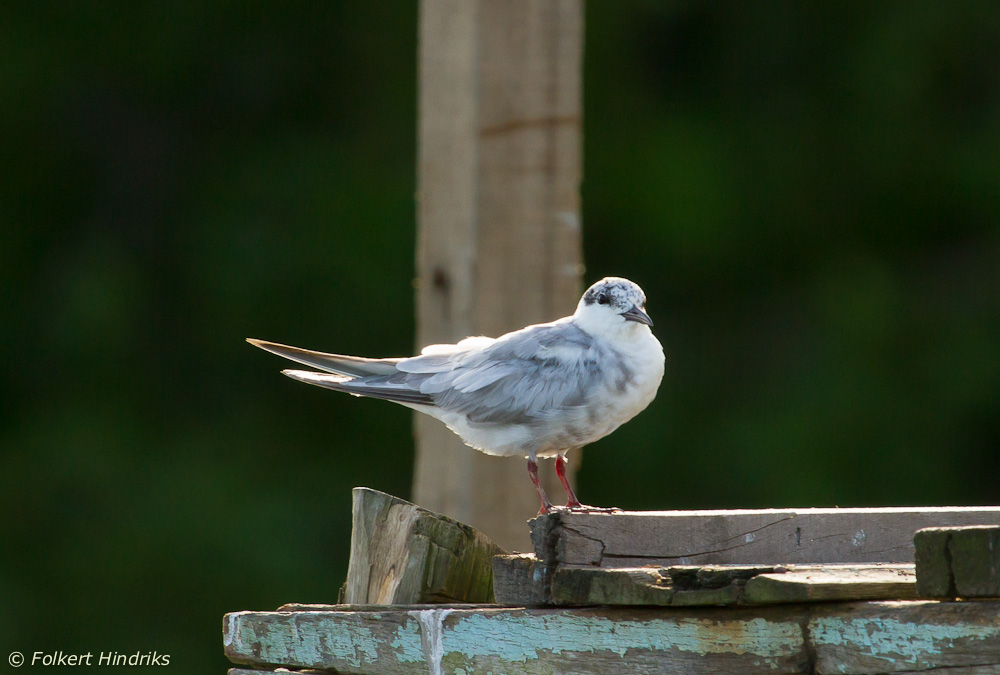
On our way back to Bandar we passed a group of terns sitting on a small wooden construction in the water providing some great picture opportunities. I struggled a little with a quick identification, but am fairly certain these are whiskered terns. Primarily because of the relatively heavy bill and lack of distinct "headphones" that can be expected on white-winged black tern. Of course I should also have payed a little more attention to the color of the rump when some birds flew of...
Whiskered tern (Chlidonias hybrida).
I am planning a trip to Bukit Pagon (highest peak in Brunei) with some friends in two weeks from now.  Very much looking forward to that!

Folkert, 03/12/2012

Saturday, 17 November 2012

Early November morning at KB road

I went for a short morning visit to the KB road this morning. It has been well over a month since my last trip to Kuala Balai, so it was about time as well. The morning started a little disappointing with a drizzle and grey skies. While approaching the forested area, I noticed that the clearing they started a few months ago now was adorned with the first signs of construction. I fear the amount of forest disturbance is already increasing and this unfortunately only adds further to the trend.

The birding was really good though this morning.

As I slowly drove up the road I soon noticed this male emerald dove foraging on the tarmac.
Male Emerald dove (Chalcophaps indica).
Though regularly encountered, these doves are usually very secretive. Most views are of birds quickly flying past. I have seen them foraging on riverbanks during boat trips in the past, and they seemed undisturbed by the boat. The early morning light made it very hard to get any great shots. The pictures above and below are the best I could manage of these splendid forest doves.

Male Emerald dove (Chalcophaps indica).
As my first record of the red-billed malkoha at KB road was only last month (see also Another visit to KB road) I was a little surprised to see them yet again this morning. I am not complaining though!

Red-billed malkoha (Phaenicophaeus javanicus)
My best bird of the morning was without a doubt this blue-winged pitta, that was foraging in the grass next to the road. These colorful birds are relatively common winter visitors to Brunei. PNHS historic records show that a couple of birds also wintered in the Panaga gardens in the past (and may still do so today). Pittas are notoriously secretive and unless you have one wintering in your garden, they're not the easiest species to see!
Blue-winged pitta (Pitta moluccensis).
As I was standing in the middle of the road, in plain sight, I couldn't get any closer. Still, the bird allowed me with a couple of minutes of unobstructed views while it was hopping about, occasionally standing upright to take in it's surroundings.

Blue-winged pitta.
Making my way back to the car a couple of wrinkled hornbills landed not too far away. Described as uncommon in Borneo, this species of hornbill is commonly encountered along the KB road and a few birds can be seen flying overhead on most visits. Close-up views are not easy to come by though.
Male Wrinkled hornbill (Aceros corrugatus).
Folkert, 18/11/2012